





What is reef safe and water resistant?

At burnd, we’re lifelong outdoor junkies. We surf, ski, hike, paddle, bike, row, camp, golf, play tennis and a bunch of other stuff—rain or shine. Nature isn’t just our playground, it’s our home. And like any good homeowner, we want to take care of our house.
But caring for the planet takes more than catchy slogans and Instagram-ready buzzwords. Case in point: “Reef Safe.” It sounds responsible, noble even. But peel back the label the reality is much less clear.
What Exactly Does “Reef Safe” Mean?
Short answer: Not Much
There’s no legal definition of "Reef Safe," "Reef Friendly," or "Reef Anything"—so any brand can slap it on a bottle regardless of what’s inside. At burnd, we don’t play that game. We don’t traffic in meaningless marketing language.
That said, consumers who care about reef safety generally expect products not to contain certain ingredients—primarily oxybenzone, and sometimes avobenzone, octocrylene, or octinoxate (all organic sunscreens and commonly referred to as "chemical sunscreens").
Where Science Meets Misinformation
Yes, oxybenzone has been shown in laboratory settings to harm marine life at high concentrations, including coral bleaching. And yes, a lot of beach water samples show levels approaching those thresholds. That’s real. But let’s not throw the entire sunscreen aisle under the boat.
Take octinoxate, for example—frequently villainized in the same breath as oxybenzone. Yet in one study of 19 Hawaiian beaches researchers found zero detectable octinoxate in surface water samples and minimal amounts in other places, while oxybenzone was found at every single site. A separate study in the Mediterranean had similar results.
So why the difference?
The Science of Sunscreen in the Sea
It comes down to solubility, stability and formulation.
-
Water solubility: The more water soluble a molecule is, the more likely it is to wash off in the water. While none of the organic sunscreens commonly used would be considered highly water soluble, some are more soluble than others. Oxybenzone is ~ 100x more soluble in water than octinoxate. That means it washes off more easily and ends up in the ocean.
-
Photostability: Oddly, sunscreens break down in sunlight. Some degrade quickly and vanish. Avobenzone is a good example. It is notoriously unstable in sunlight but can be largely fixed if used with octocrylene and that's why you almost always see these two together. Others, like octocrylene, which is highly photostable, linger, which may explain why it’s frequently detected.
-
Formulation: This is the real game-changer. In short, certain kinds of formulations hold the sunscreens on your skin, and out of the ocean, better than others.
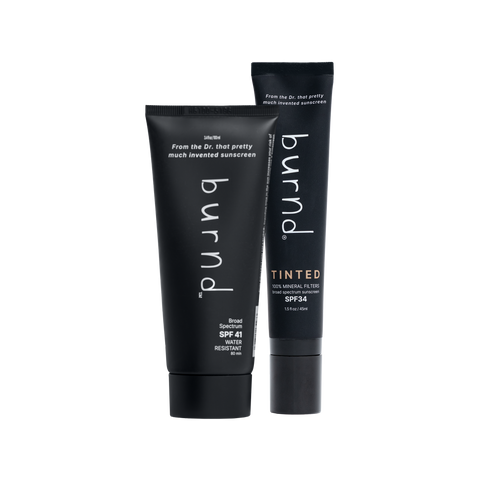
At burnd, we use a reverse emulsion technology that locks in sunscreen during activities, keeping them out of the water. It makes our product highly water-resistant and gentle on the skin. In independent testing, our SPF 41 doesn’t lose a single point after 80 minutes in water. That’s not magic—it’s chemistry done right. Many so-called "sport" sunscreens use inferior technologies that don’t hold up nearly as well.
Hormone Stuff: Endocrine Disruption
Not surprisingly, the information on sunscreens and hormonal disruption is very similar to the reef safe story. Some information on very high levels of sunscreens in test tubes indicated they can interact with hormone receptors, so called hormone or endocrine disruption. In the case of oxybenzone but not the others, this was also shown in animals, albeit at doses much higher than real-world exposure. Having said that, there is not a compelling reason to use it and most companies have eliminated it from their newer products.
The bottom line is this is another case of valid science turned into clickbait. A recent peer reviewed review of this concluded that there was little risk of biologic activity of octinoxate at real world use levels*. As for oxybenzone, burnd does not use it.
So What Does burnd Actually Do?
We use our heads. Here’s how we protect you and the planet:
-
No oxybenzone. The easiest decision on the planet. Not great for the environment. Not great for your skin either—it’s a known irritant. And not a great sunscreen to begin with.
-
Hybrid UV protection. We combine organic and inorganic filters to get maximum SPF with minimal environmental load.
-
Reverse emulsion technology. Keep sunscreen on your skin and out of the water.
-
No parabens. Our preservative system is planet-conscious and skin-friendly.
-
No nonsense. We’re transparent about what we do and why we do it.
This isn’t about fear. It’s about facts. You deserve sunscreens that protect your skin without trashing the ocean or offending your intelligence. At burnd, we’re don’t chase trends. We're performance driven, pure and simple.



Want to learn more from us?
By signing up, you agree with our privacy policy.